

I played violin in church on Palm Sunday.
And during the song, I royally f’ed up.
Let’s pause right here.
I’ve noticed that the first impulse of most people is to immediately jump into “I’m sure it wasn’t that bad!” “I didn’t notice anything!” “You’re your own worst critic!” “No one could even tell!”
And as genuinely kind as I believe this impulse to be—and as reassuring (albeit delusional) as it can feel at times—I want us all to take a deep breath and resist the temptation to do this for a moment. Just a little moment!
I was very disappointed, and very embarrassed, with the way that I played my violin in front of my congregation on Palm Sunday.
Eeeeek, I know it’s uncomfortable—stick with me. I don’t want to gloss over that feeling of disappointment and embarrassment, because it’s actually the point of what I write for you today.
Hi, my name’s Mollie, and I’m not that good at the violin.
Okay, I used to be good at the violin.
Already I feel the urge to tell you this as a way to soften the shame I feel around my recent performance. In other words, I feel as though telling you “well, you see, I used to be really good” is a way of saying “I wasn’t always this bad; please don’t judge me too harshly.”
Because if I was always this bad, what kind of delusion would this perfectionistic 31-year-old be under to think that she could actually play her instrument in front of people?
The inner monologue goes something like: You’re an adult now, Mollie. It’s cute when kids mess up. It’s not cute when you mess up. It’s just embarrassing for everyone. It’s adorable that you’re challenging yourself or whatever, but why don’t we stick to things that we can actually do, huh?1
For most of my life, I have run like hell away from things that made me feel embarrassed, inadequate, or disappointed in myself. I’ve gotten really good at not doing things I’m not good at. And to help me with that, I’ve gotten really good at making excuses for not doing things that cover up the real reason I don’t want to do them.
“Sorry, I’m just too busy to make it!” is way easier to say than “I’m way too anxious to go to that event alone, because I’m worried I’ll say something stupid or be super awkward and people won’t like me.”
“I’m kinda sick right now” is way easier than saying “Yeah, my voice just cracked when I was singing this song and that was super awkward and embarrassing for me and now I want to crawl in a hole.”
“I just want to watch and keep stats!” is way easier than saying “If I play softball with our grad school intramural team, all these people will see when I inevitably run too slow or swing too slow or drop the ball when I’m supposed to catch it, and that’s mortifying.”
You see what I mean?
These super specific examples are only three of countless scenarios I could recount.
Pause: Can you come up with a few of your own? Follow this same format for 1-3 examples from your life. Write them down!
I do think there are people out there for whom it is easier to do things just for the fun of it, even when they know they’re not going to be good, and I really admire these people. But even for those people, I’m sure there are limits. We all have certain ideas about ourselves—identities and stories that make up who we are. We use these ideas to shape how we present and speak about ourselves to the world. On the one hand, we have these parts of ourselves that we put front and center for others to see (and approve of). And on the other hand, we all have parts of ourselves that we would rather no one else see.
I’m not a psychologist, but I do wonder if the identities that we hold onto the strongest are the ones that are most likely to be hiding something more tender.
This brings me to ballet.
I was a dancer growing up. I loved it, and I was decently good at it. I was never going to be a professional dancer, but I did well in my classes and performances.
Like performing the violin, it was thirteen years since I took a ballet class.
Until seven months ago.
Back in September, I found out that a friend of a friend taught a weekly adult ballet class, and I felt an immediate surge of “I need to do this.” I missed dancing so much, and I needed some new form of movement for the health of my body and mind.
So I told this teacher—who I really liked and wanted to be friends with and definitely didn’t want to embarrass myself in front of—that I was coming to her class, and then the following Wednesday, I forced myself to show up.
I was incredibly anxious. I was excited to finally return to something I once loved, but also scared that I wouldn’t be able to do any of it anymore.
I went to the class, and I tried my best. My mind was a mess the whole time. Every time I couldn’t do something that I remembered once being able to do, I felt frustrated with myself. I was mad at myself for losing what I had once worked hard for. I was angry that my body was so different from how it used to be, that things were so much harder now.
But when I got home, I was elated. Looking back on the night from the comfort of a hot bath with lots of epsom salt, I realized how much fun I had (underneath all the layers of self-deprecation).
That doesn’t mean I stopped being hard on myself. I dug up old pictures of myself on pointe to remind myself that despite my embarrassing showing that evening, I did used to be good. (I used to be good, okay?! Soften, shame, soften!!) I found it easier to reminisce on old performances and old memories than to remember what I witnessed that evening in my stiff, sore, and still-feeling-it-from-postpartum body.

Y’all, I was so sore I couldn’t walk right for two days.
But the next week, I decided to go back.
It’s April now, and I’m still walking into the studio every Wednesday night in my leotard and tights.
The point of this piece is not to brag about anything. I’m not trying to use myself as some perfect example of how you should be living your life.
The point of writing all of this is to reflect on the ways I’ve been letting go of the fear of being not that good (F.O.B.N.T.G.? Doesn’t really roll off the tongue) and to ask, what is this fear hiding underneath it? What is this fear preventing me from seeing or experiencing?
It is not currently a goal of mine to ever play violin professionally or dance in a public performance. Consciously, I know that has nothing to do with whether or not I should play or dance if it makes me happy to do so. I wonder, though, if I have somehow convinced myself subconsciously that if I’m not doing something at the highest level, it’s not really worth doing; it’s not really worth embarrassing myself over.
It feels great to succeed at things. It feels amazing to be good at stuff, and even more amazing for someone else to tell me I’m good at stuff.
But my life cannot be filled by only the things that feel the most amazing.
I worry that if I spend so much time running away from (even potential) discomfort and embarrassment, I am missing out on something essential about what it means to be human. Mathematically and common sense-ally, we cannot ALL be the best at something. Duh. But the world stretches out in infinite ways in front of us anyway. The classes we could take, the conversations we could have, the skills we could hone, the people we could know, the things we could create—they are countless and they are right in front of us.
So where do I go from here?
Well, first of all, I’m going to play my violin in church again. I know going in that I might mess up. That’s okay. I want to be someone who shares my music with my faith community.
And I’m going to keep going to ballet. I am terrible at pirouettes. I don’t have very good balance and my leaps are low. My mind gets jumbled and I forget more combinations than I remember. But every week when I find my spot at the barre and the music begins, I feel centered and calm. I see myself in the mirror and I feel graceful. I feel like I can embody the things I hear in the music, and I love the shapes my body can make. I want to be someone who relishes in the movement of my body.
So yes, I’m letting go of the attachment to being good at everything I do.
But that’s not all–
I’m also letting go of the attachments to being bad at them.
It seems like an odd concept for someone to be attached to being bad at something, but it’s not really that strange. When we decide we’re not good at something, we get so caught up in what we’re telling ourselves about it that we literally cannot get past it.
Telling ourselves and others that we’re bad at something is a safety blanket that prevents us from having to show ourselves and others that we’re bad at it.
It’s so much easier to say “no I’m so bad at that lol!!!” than to try something, be bad at it, and be seen to be bad at it.
If I’m honest with myself, I know there are things that I’m bad at. Like I said, pirouettes. Repeating dance combinations on the left side. Getting a clear tone on super high notes on the violin.
But I have not been cursed by an evil sorceress to be bad at all of these things forever. Maybe I will get better at them one day. Maybe I won’t. But that has no effect whatsoever on whether or not I can attempt them, whether or not I can practice them, or whether or not I can enjoy the process of trying.

My “being not that good” journeys with violin and ballet are going pretty well. You could almost say I’m getting pretty good at being not that good.
But oh man, do I have a big, scary something else. Here we go again with the “I used to…”
I used to speak Spanish moderately well. I took Spanish classes in middle and high school, but most of my learning came from my traveling to the Dominican Republic and making friends there over the course of five or so years. I first went with a church group, then after forming some great relationships and enjoying the ministry and social work I got to learn and practice with my community there, I kept going back.
Having gone on all of these trips, I could mostly hold a conversation in Spanish. To be honest, understanding native adult speakers has always been a challenge for me, but I could get through. I made some mistakes, laughed them off, and all was relatively fine.
But it has been a lot of years since then. I haven’t practiced very much. I’ve lost much of the skill I once had.
And now I live in Texas. I know tons of native Spanish speakers here—including my next door neighbors, who I love spending time with.
But nobody really knows that I can speak some Spanish. Because I haven’t told them.
Once again, it all comes down to embarrassment. Embarrassment at messing up, fear that I won’t understand what someone is saying to me, discomfort with, again, being bad at this. And guilt that I could get this far into knowing someone without telling them I speak some of their first language.
But here’s the sticking point: My refusing to speak Spanish is actually against my values. Being a person who refuses to even attempt to speak Spanish with someone who has had to learn English to function in this country is not the person I want to be.

I believe in my heart that learning and speaking the native tongue of many, many of the immigrants here is an act of hospitality. I know that speaking someone’s native language to them, even in a broken way, can make them feel loved and embraced, or at least more at ease.
And even though I know and believe these things, I consistently don’t do them.
I can’t be the person I want to be if my actions don’t align with who she is.
So this is what’s next for me. I want to embrace being not that good (yet?) at Spanish and speaking it anyway. This one feels really scary to me. But it also feels deeply important. (Feel free to appoint yourself my accountability buddy and check in!)
What about you? What are you going to practice being not that good at?
Sending you lots of love as always.
Nos vemos, querides,

Rev. Mollie Donihe Wilkerson (she/her)
molliedonihe.com
If you liked this, you may also enjoy this piece on the scariness of spiritual practice. And if you found my work meaningful, consider buying me a coffee. <3
P.S.
The Rahab Stole is now available! Get it Made to Order here.
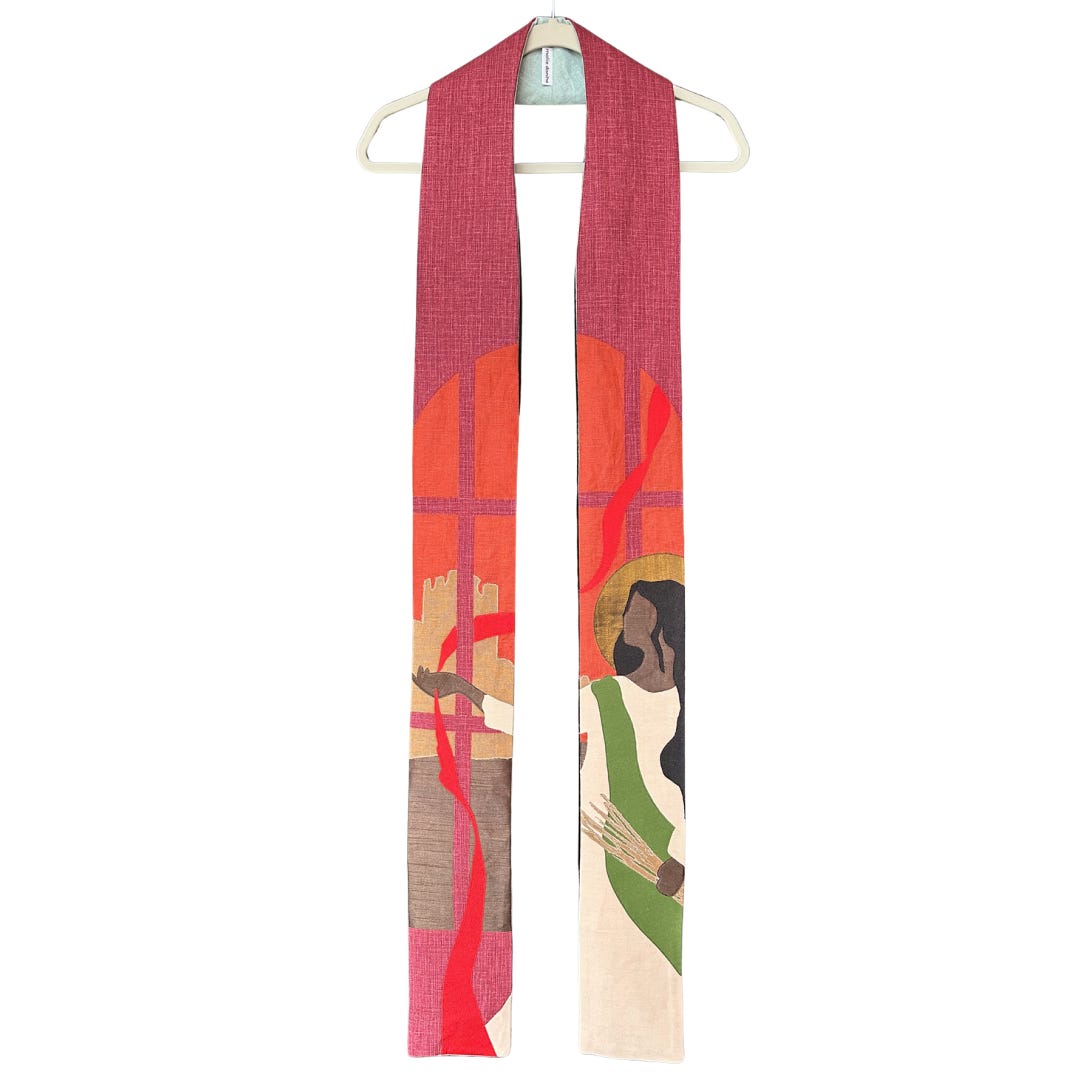
And for your upcoming graduations, ordinations, or installations, I have gift registries available! (Who said we can only have registries for weddings and babies??) Help your friends and family celebrate you with stoles, artwork, and more. Email me at info@molliedonihe.com to set up your registry.
Btw, I just want to note that if any of my friends talked to me like this, I would literally never hang out with them again. It’s so catty and mean. Just know that I am aware of this. I’m working on it.
I'm in the midst of learning a new way of working my art practice that is not as demanding on my aging joints. It can be frustrating (and occasionally rewarding) and it's something I really need to do to keep growing. Keep trying, keep being honestly vulnerable. The cracks in our perfection is where the light comes in!